Swiggy Customer Alleges 80% Price Hike Compared to Restaurant Offline Rates, Sparking Debate
 PakkaHyderabadi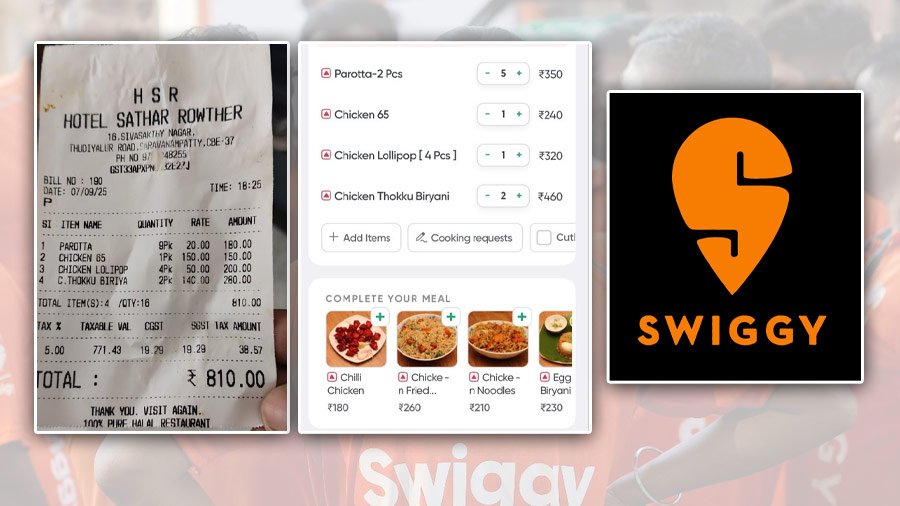
A Coimbatore customer’s social media post reveals an 80% markup on Swiggy food delivery prices, igniting widespread discussion on platform pricing and consumer transparency
Swiggy User Calls Out 80% Price Hike, Sparking Debate on Food Delivery Costs
A Coimbatore-based Swiggy customer, Sunder (@SunderjiJB), has ignited a heated conversation on social media by sharing that his Swiggy food order cost him a staggering 80 percent more than buying the same dishes directly from the restaurant just two kilometers away. Sunder posted detailed screenshots comparing bills, noting that his Swiggy order for 10 parathas, chicken 65, four chicken lollypops, and two plates of chicken thokku biryani totaled Rs 1,473, while the same dishes bought offline cost only Rs 810. Highlighting the inflated prices, he wrote, “Eighty percent inflated price to deliver food is way too much. Next time I will book Porter to go grab my order for just Rs 100.”
Who’s Responsible? Restaurant Markups or Platform Fees?
Several users quickly pointed out that the price inflation is largely driven by restaurants themselves, who raise menu prices on delivery platforms to cover the commissions charged by Swiggy and other apps. Aarushi Panchal (@panaaru) clarified, “These are restaurant charges. Not Swiggy charges. Swiggy charges the restaurants for visibility, and that is the additional cost that you see.” Others warned that this workaround, where restaurants inflate prices to offset platform fees ranging from 24 to 28 percent, could destabilize the food delivery ecosystem in the long run.
Swiggy’s Stand: Pricing Is at Restaurant’s Discretion
Responding to the backlash, a representative from Swiggy Cares stated, “We’re trying to maintain transparency in our services… the prices might be different online and offline as it is the sole discretion of the restaurant.” This means Swiggy does not control the menu pricing itself; rather, restaurants decide the rates on their online listings. Zomato’s official disclosures echo this, explaining that commissions and restaurant-funded advertisements impact pricing too, with platforms remitting a net amount to restaurants after deducting these costs.
Convenience vs. Cost: The Growing Consumer Dilemma
Sunder’s post has sparked a broader debate over whether the convenience offered by food delivery apps justifies the steep markups. While many urban consumers accept moderate delivery fees for the ease of home service, an 80 percent price difference has raised concerns about hidden costs, transparency, and potential exploitation. With upcoming GST hikes on delivery fees and increased platform charges, this conversation highlights a crucial question: what is the true cost of convenience?