
Undersea Cable Cuts in the Red Sea Disrupt Internet Access Across Asia and the Middle East
 PakkaHyderabadi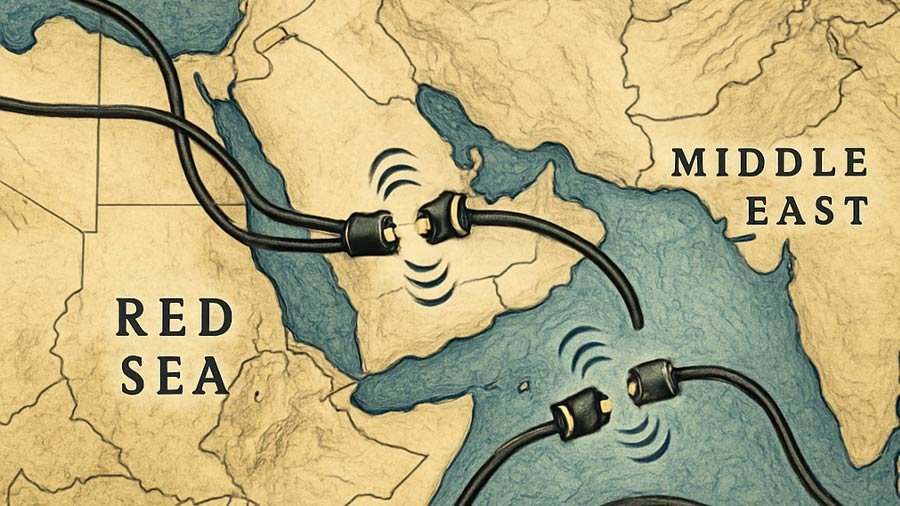
Multiple critical undersea cables in the Red Sea were cut near Jeddah, Saudi Arabia, causing internet slowdowns and outages from Asia to the Middle East amid regional conflict concerns
Undersea cable cuts in the Red Sea have caused widespread internet disruptions across Asia and the Middle East, impacting countries including India, Pakistan, Saudi Arabia, UAE, and Kuwait. Global watchdog NetBlocks reported that multiple subsea cable outages degraded connectivity in the region, identifying faults in the South East Asia–Middle East–Western Europe 4 (SMW4) and India-Middle East-Western Europe (IMEWE) cable systems near Jeddah, Saudi Arabia. Microsoft also noted increased internet latency in the Middle East due to these fiber cuts but said its Azure services are back online after initial disruptions.
The SMW4 cable is operated by Tata Communications, part of India’s Tata Group, while the IMEWE system is managed by a consortium led by Alcatel-Lucent. Kuwait’s FALCON GCX cable, also running through the Red Sea, was reportedly damaged, causing internet slowdowns in the oil-rich nation. Pakistan Telecommunications confirmed the cable cuts and service impact, while UAE’s Du and Etisalat networks reported slower speeds. Authorities in Saudi Arabia and Kuwait have not commented, and cable operators have yet to provide official statements.
Possible causes of the damages include accidental disruptions by ship anchors and suspected sabotage amid ongoing regional conflicts involving Yemen’s Houthi rebels and the Israel-Hamas war in Gaza. The Houthis denied responsibility for the cable cuts but acknowledged awareness of the outages. Yemen’s internationally recognised government directly blamed the Houthi militia, calling on the international community to secure the vital digital infrastructure critical to the modern world.
Repairing these undersea cables is a complex, time-consuming task that requires specialised vessels and technicians to locate and fix the faults. Experts say such repairs can take weeks or even months, as the cables are buried deep underwater and surrounded by challenging maritime conditions. The outages highlight the vulnerabilities of the global internet backbone and underscore the growing cybersecurity and geopolitical risks to essential communications infrastructure.
Over the past two years, Houthi rebels have increased attacks on maritime targets in the Red Sea, including missile and drone strikes on commercial ships. These attacks have led to significant maritime losses and drawn retaliatory airstrikes by Israel and the United States. The current cable disruptions add another layer of strain on already fragile internet and communication networks across these strategically important regions.